
Compound interest explained
Compound interest means you earn interest on both the money you originally save and any interest that has already been added to your account.
Sometimes called “interest on interest”, the interest earned in one period can itself earn interest in future periods, increasing the amount in your account.
Why time matters for compound interest
When interest is added to your savings, it can increase the balance used to calculate future interest. Over time, the effect of compound interest can become more noticeable because you earn interest on both the original amount saved and interest added previously.
How compound interest builds over time
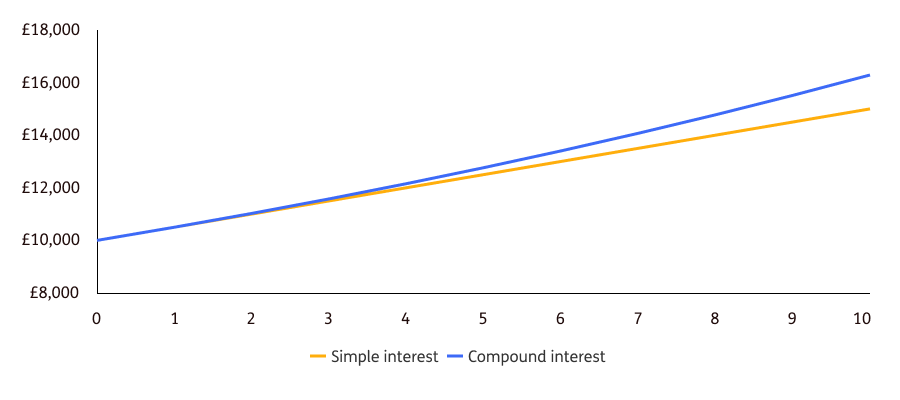
Here’s how it could work if interest was fixed and paid annually over 10 years. Let’s say you save £10,000 and earn an interest rate of 5%.
The chart below compares simple interest and compound interest. With simple interest, interest is only earned on the original £10,000, but with compound interest you earn interest on both the original savings and any interest already added to the balance.
After 10 years, the simple interest balance would be £15,000, while the compound interest balance would be £16,288.95.
Example of simple vs compound interest over 10 years
| Simple interest balance | Compound interest balance | |
|---|---|---|
| Starting balance | £10,000 | £10,000 |
| After 5 years | £12,500 | £12,762.82 |
| After 10 years | £15,000 | £16,288.95 |
| Total interest earned | £5,000 | £6,288.95 |
Compound interest and borrowing
Compound interest can increase your savings balance, but it can also make borrowing more costly too.
For some types of debt, unpaid interest may be added to the balance. Future interest is then calculated on both the original amount borrowed and interest already charged.
Over time, this can increase the overall amount that needs to be repaid.
Compound interest and inflation
Compound interest can increase the balance in your savings account, but it’s also worth thinking about inflation too.
If inflation is higher than the interest rate on your savings account, the purchasing power of your money may fall over time.
It's important to consider both interest rates and inflation when thinking about how your savings might grow in real terms.
Understanding interest frequency and AER
Some savings accounts add interest annually, while others add it monthly, quarterly or at different intervals.
The frequency at which interest is added can affect how compounding works. That’s why when comparing savings accounts it’s usually best to look at the Annual Equivalent Rate (AER).
AER shows what the interest rate would be over a year once the effects of compounding have been included and allows you to compare accounts on a like-for-like basis, even if they pay interest at different frequencies.
Key things to remember
Interest can earn interest
It’s calculated on both your original savings and interest already added to your balance.
Time increases the effect of compounding
Each time interest is added it becomes part of the balance used to calculate future interest.
Compound interest can apply to both savings and borrowing
The same principle can increase savings balances over time or increase borrowing costs where interest is added to an outstanding debt.
AER can help you compare savings accounts
It includes the effect of compounding and provides a consistent way to compare accounts.